



The Gombe State Government has signed a Memorandum of Understanding (MoU) with the Rural Electrification Agency (REA) to scale up the deployment of decentralised solar power generation and distribution across the state, with a strong focus on unserved, underserved and rural communities.
The partnership, driven by Governor Muhammadu Inuwa Yahaya, is designed to support the effective planning, implementation and post-implementation sustainability of electrification programmes and projects in Gombe State.
It covers power generation and distribution, productive use of energy (PUE) and a range of value-added services, including appliance sales and financing, e-mobility solutions and agro-processing initiatives aimed at boosting local productivity and livelihoods.
The MoU was signed on behalf of the Gombe State Government by the Commissioner for Energy and Mineral Resources, Sanusi Ahmed Pindiga, and the Attorney General and Commissioner for Justice, Zubair Muhammad Umar.
The Managing Director of the Rural Electrification Agency, Abba Aliyu, signed for REA, alongside the Agency’s Director of Legal Services.
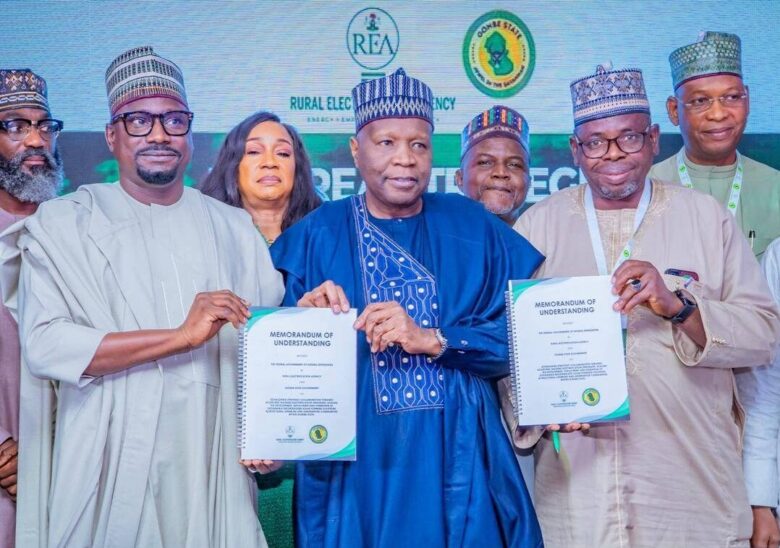
The agreement is a direct outcome of the State-by-State Engagement on Rural Electrification Roundtable, where stakeholders held robust discussions on the clean energy opportunities available in Gombe State.
The engagement was held under the theme “Powering Inclusive Growth: Strengthening Gombe State’s Emerging Clean Energy Market through Partnership and Innovation.”
The roundtable, which took place at the Transcorp Hilton Hotel, Abuja, brought together government officials, development partners, investors and energy sector stakeholders to explore practical pathways for expanding access to clean, reliable and affordable electricity in the state.
The collaboration with REA further reinforces the Gombe State Government’s commitment to leveraging renewable energy as a catalyst for economic growth, job creation, improved service delivery and inclusive development, particularly in rural communities where access to electricity remains critical to unlocking social and economic opportunities.
